← Explore FuranoFURANO, IN SEASON.
Explore FuranoTrip planning

2026.11 Furano, Hokkaido Notes before renting a car

Never driven on snow? Should you drive yourself to Furano?
Winter driving: who should, checking road closures, what to do if stuck
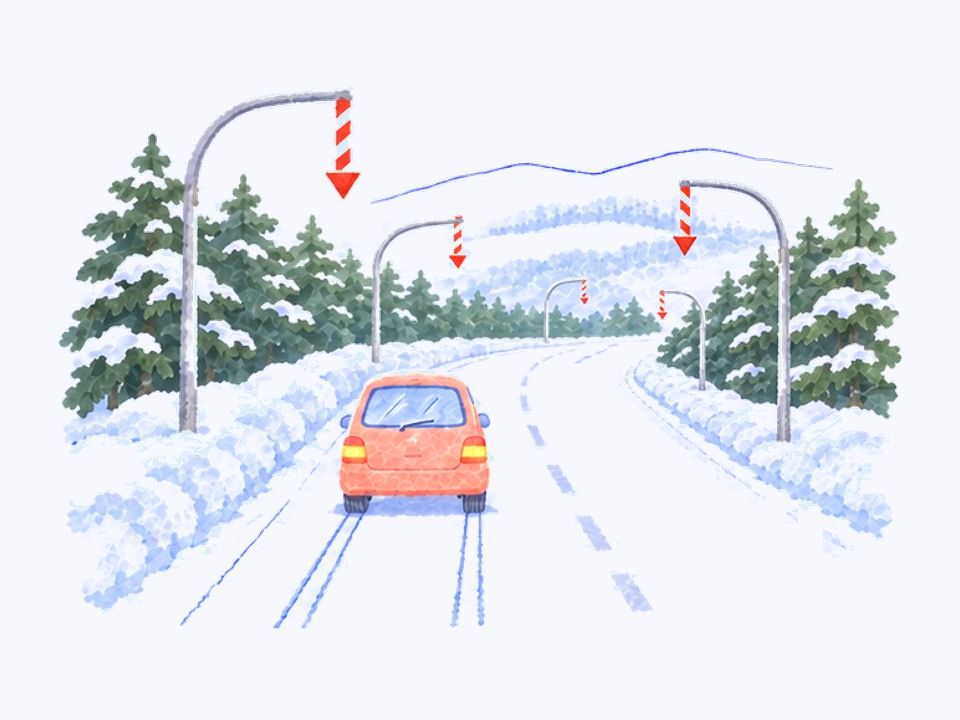
Illustration for driving yourself to Furano in winter without experience on snowy roads

You come in winter,

fields and roads all white.

What shows the road's edge

is red and white arrows above.

Think first, then decide.

New to icy, snowy roads?Don't start learning here.Even with experience, drive only in daylight and have a plan B without the car. Trains, buses and taxis are much easier.

Who should drive in winter

Ask yourself first, then the rental company.

You can driveYou often drive on ice and snow and know how to keep the steering steady in a skid. Your trip can slip a day, and you can arrive before dark.
Just a short stretchYou have some experience: take transport to Furano or Asahikawa first, see the roads, then decide whether to rent locally.
Don't driveIt's your first time on snow, you've only driven Hokkaido in summer, your flights are tight, or you want to drive at night.

NotebookNeither snow tyres nor four-wheel drive replace experience. Four-wheel drive helps you start, not stop.

How long the drive to Furano takes, and which way

Two hours on the map means two hours in summer.

New Chitose AirportAbout 2 hr 10 min in summer

RouteDoto Expressway (道東自動車道) → Shimukappu IC (占冠 IC) → Route 237

WinterYou cross the Kanayama Pass (金山峠). When heavy snow is forecast, a stretch of about 7.4 km may close before any snow has settled.

SapporoAbout 2 hr 10 min in summer

RouteDo-o Expressway (道央自動車道) → Mikasa IC (三笠 IC) → Katsurazawa (桂沢) → Route 452 → Hokkaido Road 135 (道道135号)

WinterDon't let the satnav take you from Bibai IC (美唄 IC) onto Hokkaido Road 135: from Bibai Dam to Route 452 it is closed until 23 Apr 2027.

Asahikawa AirportAbout 1 hr in summer

RouteRoute 237, via Biei

WinterThe shortest of the three starting points, but still over an hour in winter. If you're unsure, rent once you reach Furano.

NotebookThe tourism association's times are for summer and don't include breaks; allow longer in winter. I'd plan to arrive before 15:00, so there's still a little light if you're late.

Roads closed this winter, and how to check before you go

Check the night before, and again in the morning.

Closed all seasonHokkaido Road 135 at Bibai is closed until 11:00 on 23 Apr 2027. Shirogane Onsen (白金温泉) to Bogakudai (望岳台) is closed from 11:00 on 1 Dec to 11:00 on 23 Apr. Bogakudai to Fukiage Onsen (吹上温泉) is already closed, so in winter you can't drive through from Shirogane Onsen to Tokachidake Onsen (十勝岳温泉).
Closures firstRoad Information System (道路情報提供システム): the transport ministry's live closure map, available in Chinese. Hokkaido roads only show when you tick them separately.
Overall travelHokkaido Safe Travel: check here when trains, buses or roads have major suspensions or closures. It has machine-translated Traditional Chinese. If a road isn't listed, that doesn't mean it's open.
Passes and blizzardsCheck pass conditions on Kita no Michi Navi (北の道ナビ), then warnings and snowfall on the Japan Meteorological Agency's multilingual site.
ExpresswaysDora Tora (ドラとら); during maintenance, use JARTIC instead (both in Japanese).
TokachidakeOn 20 Nov the volcanic alert level was 2, with danger within about 1.5 km of the crater. Shirogane Onsen is outside the restricted area, but check Biei town's notices and evacuation routes before you go.

NotebookIf a road is closed, don't look for a back road around it. Not going today is the best route.

Reading snowy roads: arrows, braking distance, sunset and deer

The arrows point to the road's edge.
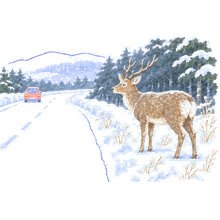
Red and white arrowsIn Japanese they're called yabane (矢羽根). They point to the outer line of the lane, so don't drive directly beneath them. The big white arrows at junctions are different: they point to the centre of the road.
How far you slide after brakingA test of emergency braking at 50 km/h (not counting the reaction distance before you press the pedal): about 10 metres on a dry road, about 35 metres on packed snow, about 112 metres on ice. Bridges, tunnel mouths and shade under trees freeze especially easily.
Early darknessSunset in nearby Asahikawa, for example: about 15:53 on 7 Dec, 16:00 on 27 Dec, 16:39 on 31 Jan and 17:07 on 20 Feb.
DeerIn 2025 Hokkaido had 6,705 deer-related accidents, most in October and November, and over 70% between 16:00 and 24:00. If you see one, slow down: there are often more behind it. Don't swerve suddenly to avoid it.

NotebookOn snowy roads the greatest danger isn't the snow, it's thinking you can stop in time.

Whiteout in a blizzard, or stuck in your car: what to do

Engine off first, then think about warmth.
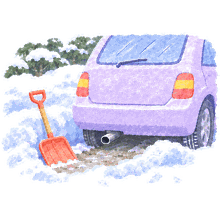
Before you set offFill the tank and charge your phone. Keep a down jacket, a blanket, gloves, hand warmers, water, food, a torch and a snow shovel in the car. Rural petrol stations are mostly closed at night.
Can't seeLights on, and slow enough to stop within the distance you can see. If you can't go on, stop somewhere as safe as possible with your hazard lights on; when calling for help, give your location clearly.
Stuck in a blizzardDon't leave the car unless you're sure you can see shelter or rescuers.
Breakdown on the expresswayThe opposite of being stuck in a blizzard. If you can see clearly around you, turn on the hazard lights and get everyone out behind the guardrail, then call 110 or #9910.
Engine off as a ruleIf you must run it, first make sure you can get out without being hit or losing your way, then dig the exhaust pipe completely clear and keep checking it hasn't been buried again. Carbon monoxide poisoning can happen even with a window open.
In dangerPolice 110, fire and ambulance 119. Help in Chinese: Japan Visitor Hotline +81-50-3816-2787 (24 hours).
Car won't moveCall the rental company first. JAF: from a Japanese number, dial #8139; from an overseas number (including Taiwanese roaming), call the line covering Hokkaido, +81-3-5730-0111. It's 24 hours, with three-way interpreting in Chinese. Non-members pay a fee.

NotebookSave these two numbers before you go: the rental company and JAF. When you're stuck, your hands will be cold.

Before renting: Taiwanese licence, tyres and winter fees

Get the Japanese translation done in Taiwan.

Bring all threeYour valid original Taiwanese licence, a Japanese translation and your passport. You can drive for up to a year from the date you enter Japan; if you renew your licence or change address, you need a new translation. Taiwan's international driving permit can't be used in Japan. People living in Japan have a separate three-month rule.
Who issues the translationTaiwan's licensing authority (the motor vehicles office) can issue it. Translations from bodies designated by Japan, such as the Taiwan-Japan Relations Association and JAF, are also accepted; JAF doesn't take applications from overseas.
TyresRental cars in Hokkaido all have snow tyres in winter. At Nippon Rent-A-Car, for example, four-wheel drive is also standard for pickups from 1 Nov to 20 Apr, but snow chains aren't provided.
Extra costsSome rental companies charge a daily winter fee, so check the total when you book. The collision damage waiver (CDW) usually doesn't cover the non-operation charge (NOC), so ask about it separately.
Report even small bumps to the policeTell the rental company on the spot too. Without a police report, insurance and cover may not apply at all.

NotebookThe single most useful question when booking: "If I get stuck in snow, who pays to tow me out?"

Biei's trees and the Blue Pond: where to park

No car park means no parking.

Christmas TreeThere's no car park, and don't stop on the road in front of it either: residents and the school bus use it. Take a taxi, or book the Christmas Tree bus: it leaves from beside Biei Station, 1 Dec–28 Feb, not running 31 Dec–5 Jan.
Fields and snowfieldsEven under snow, they're farmers' fields. Don't walk in, and don't stop at the roadside to take photos.
Blue PondThere's a car park: ¥1,000 for a standard car, about 220 spaces, 8:00–21:30 in winter. After the lights, the way back is always a night drive.

NotebookIf you want to see the Blue Pond lights but aren't used to snowy roads, leave the car at your lodging that night. The illumination bus needs booking and runs only on Fridays and Saturdays from 20 Nov to 13 Feb (not on 1 or 2 Jan); on other days, book a return taxi in advance.

What people who went say

Biei, winter 2025–26Heavy snow: the morning began with clearing thick snow off the car. On a narrow road they met a snowplough, couldn't pass, and had to turn round, so the plans changed too.
The same winter, another travellerDrove at night to see the Blue Pond lights: slowly on snow, and one stretch had no streetlights and was pitch dark.

NotebookWinter has easy driving days and nights when you can't see. Someone else's smooth trip isn't your road that day.

FAQ

Can I drive to Furano if it's my first time on snow?

Not recommended. The Furano Tourism Association says plainly that driving here takes solid winter driving experience.

Is a four-wheel drive rental safe?

No. It helps with starting and climbing hills, but doesn't shorten your braking distance.

Can I drive in Hokkaido on a Taiwanese licence?

Yes. Bring your valid original licence, a Japanese translation from a designated body and your passport, within a year of entering Japan.

Snow hides the road's edges.

When you can't see,

not going is travelling well.