
 Fields & farms
2026.11 Biei and Furano Notes by the fields
By the fields of Biei, why can't you take one more step?
Why you can't walk into the fields, and where you can take photos from the road
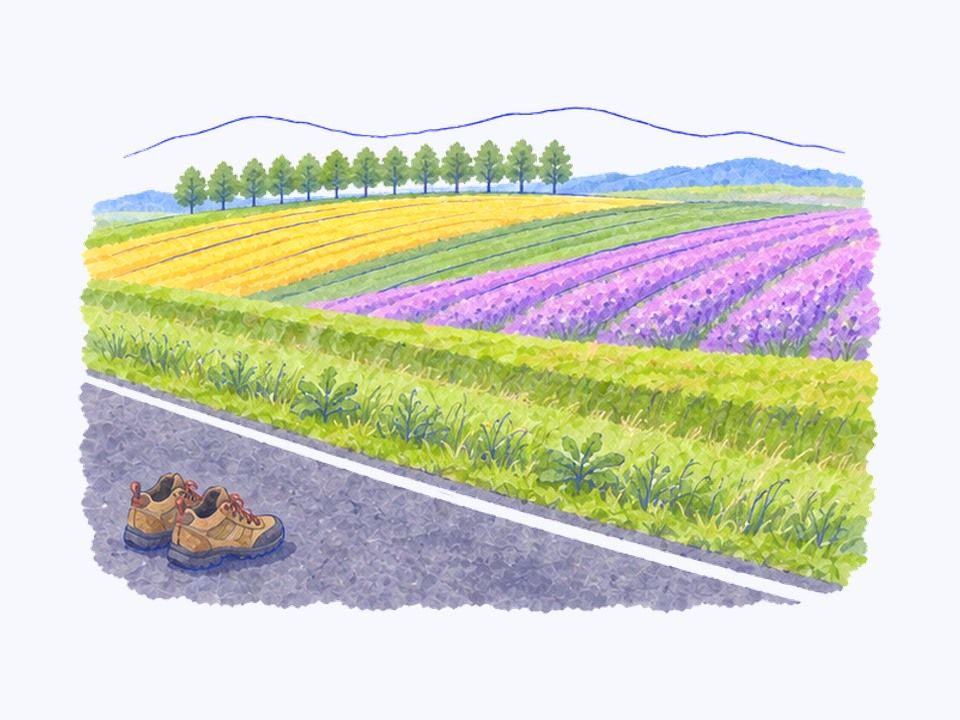
Take one step forward,
your soles carry soil in.
Whatever the month,
it's a farm's daily workplace.
Under the snow: autumn wheat.
Photos without that step: where to shoot in Biei
From the roadside, the hills spread out before you.

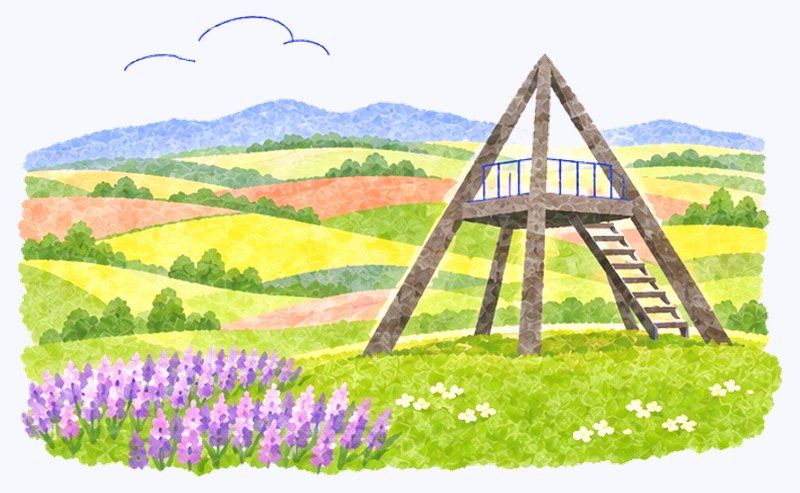
Without a car: no regular bus serves these lookout parks. You can hire an electric bike outside Biei Station, or take the summer sightseeing bus Biei-go (びえい号). Bikes are hired out from June, but not on rainy days or in the snow season; an ordinary bike starts at about ¥600 for 1 hour, and electric ones cost more. Biei-go must be booked and stops at Hokusei no Oka for 20 minutes (in 2026 it already ended on 27 Sep).
Months and times for photos in Biei
Apr–MayFreshly turned soil
What to seePatches of brown fields, and the last snow on distant mountains
Field mannersTractors are at their busiest; let farm machines go first on the road
Jun–JulPotato flowers
What to seeWhite and pale purple flowers from late June to mid-July
Field mannersThe flowers are a crop; look from the roadside only
Jul–AugWheat fields and straw rolls
What to seeWheat turns gold in mid-July; after the harvest, straw rolls peak in August
Field mannersDon't walk up to the straw rolls lying in the fields either
Sep–OctMustard flowers and autumn leaves
What to seeYellow flowers from mid-September to mid-October; leaves start to turn red from mid-October
Field mannersThe yellow flowers are grown to feed the soil; don't walk in
Nov–MarSnowfields
What to seeSnowy hills and trees standing one by one
Field mannersThe lookouts close in the snow season; there is wheat under the snow, so don't step on it
- What time: in the hour after sunrise and before sunset, the light is low and the rise and fall of the hills shows best (our suggestion, not official). Early morning and dusk are also when bears are active: only take photos in open places with other people around
Calculated by the National Astronomical Observatory of Japan (Biei, 0 metres above sea level).
Want to see the fields up close? Look for a guided tour that has the farm's permission and has you change into wellies; or buy seasonal vegetables at a JA farm shop. That is another way to get close to this land.
Why you can't walk into the fields
It is someone's field, and next year's potatoes.
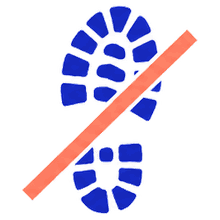
- Soil from the field sticks to your shoes, and it may hold nematodes you can't see.
- Walk into the next field, and the soil goes with you.
- Nematodes stay in the soil and stop potatoes growing well.
A notice from JA Furano (JA ふらの, the Furano farmers' cooperative) puts it plainly: entering fields can bring in soil pests and diseases such as the potato cyst nematode. The Hokkaido government also asks farmers to clean the mud off their machines and work boots after each job.
To be clear: the "pale potato cyst nematode" that Hokkaido is urgently fighting is around Abashiri, not in Furano or Biei. But it is not the only pest or disease spread through soil, so stay out of every field.
It is the same in winter, when all is white. There is wheat sown in autumn under the snow, and the snowfields are private land too.
How locals see tourists walking into fields
This has been reported many times in Japan, and the comments are often angry: some say it should be treated as a crime, others say just put up fences.
In 2018 someone in Sapporo posted photos of visitors walking into a field online, with the line "Please don't come to Hokkaido any more." The town of Biei told the media that when farmers phoned and staff rushed over, the people had often already gone; the report likened it to "cat and mouse."
Perhaps no one had ever told them. So remember before you go: don't walk into the fields.
What someone who worked there wrote down
- April: so much rain that the tractors couldn't get into the fields
- August: some of the potatoes they helped harvest go into crisps made with the Furano farmers' cooperative
- From putting up greenhouses in spring to the autumn harvest, someone is working in these fields every day
Source: Sasurai Nogyo Nikki (さすらい農業日記), by a seasonal farm helper (2025). Taken from a public record written by someone who worked there; the figures are for that year.
Problems with people entering fields
- 2016Biei's "Philosopher's Tree" was cut down by the landowner; reported reasons included the risk of falling branches and visitors repeatedly stepping into the field for photos
- 2017Biei set up a photography association and photo rules, promoted in English, Chinese and Korean
- 2019Biei farmers raised money themselves to put up signboards with the landowners' names and where photos are allowed
- 2025The mayor of Biei announced the "Touristship Declaration (ツーリストシップ宣言)" (a pledge to be a good traveller)
- 2025–2026About 1.2 km of town road around the "Christmas Tree" became pedestrian-only by day for part of the winter; a shuttle from Bibaushi (美馬牛) Station was trialled
- 2026Visitors asking to use toilets in private homes became a new problem; the town plans to open the toilets outside Bibaushi Station all year
Where you can walk by the fields
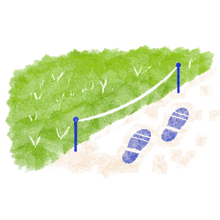
| ○ Yes | The side of paved roads (out of the way of cars), lookout parks, and paths in flower fields open to visitors |
| × No | Gravel farm tracks (they are private), fields, pasture, and snowfields in winter |
The Biei cycling map puts it simply: "As a rule, you may go only as far as the paved road."
- Don't take photos in the roadway or block the road; give way when cars come, farm machines first, and don't force your way past tractors
- Don't park on the roadside (there is no car park at the Christmas Tree)
- Drones: banned in principle within the town of Biei, unless you have a flight permit and the landowner's consent; also banned inside Farm Tomita
- Don't pick flowers or fruit; no tripods inside Farm Tomita
- Ask before photographing people, farmers included
- Take your rubbish home. The Biei Tourism Association says plainly that littering is against the law
What the Japanese signs by the fields mean
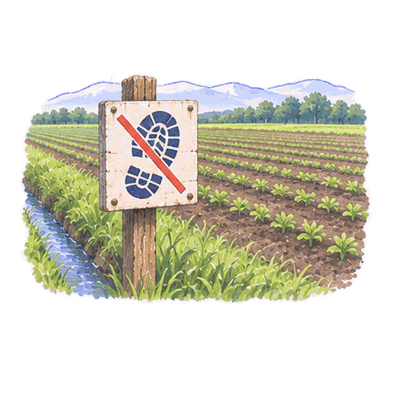
| 立入禁止 | No entry |
| 私有地 | Private land |
| 農作業優先 | Farm vehicles have priority |
| 畑に入らないで | Please don't enter the field |
| 駐車禁止 | No parking |
Many fields have no fence and no sign. No sign doesn't mean you may go in.
To see Biei and Furano together and plan how many days: read this; for the best months for flower fields: read this.
FAQ
If there's no fence, can I still not go in?
No. Almost none of the fields here are fenced. No fence doesn't mean you may go in.
Not even one step into the field for a photo?
No. Bringing in pests and disease doesn't take a long walk; the soil from one step is enough.
When it's all white in winter, is it still a field?
Yes. The Biei Tourism Association explains that crops are growing under the snow, and the snow-covered hills are all private land too.
Can I fly a drone for photos?
It is banned in principle within the town of Biei. The only exception is with a flight permit from the Ministry of Land, Infrastructure, Transport and Tourism and the landowner's consent.
Can I drive to the Christmas Tree?
There is no car park there, and in winter 2025–26 part of the surrounding road was pedestrian-only by day for a time; this year, follow the notices. From 1 Dec 2026 to 28 Feb 2027 you can take a round-trip bus from outside Biei Station (a guided tour from ¥2,000, book 2 days ahead; no service 31 Dec–5 Jan). Check the latest notices from the Biei Tourism Association before you go.
Stop where the tarmac ends.
From the road, just as lovely.
Next spring, farmers return.
Read next
 Furano without a car: by train and bus to the flower fieldsGetting to the lookout parks without a car→
 Furano in July: which week is lavender at its most beautiful?Lavender in July→
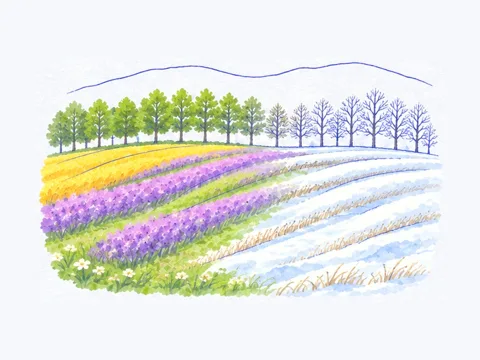 Summer flowers or winter snow: when should you visit Furano?What colour the hills are each season→
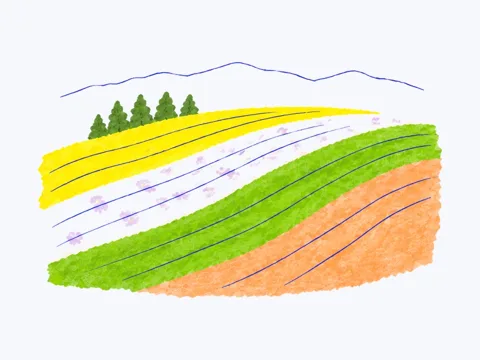 The colours of Biei's hills are grown by farmersHow the slopes and colours came to be→
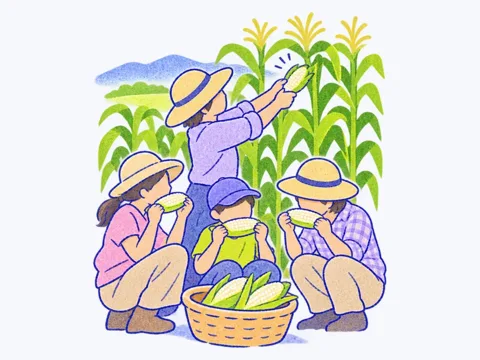 Step into Furano's fields and be a farmer for half a dayYou can go in when someone takes you→
Sources: 27
- Biei Tourism Association: winter sightseeing buses 2026–27 (Japanese)
- Biei Tourism Association: the hills through the seasons (Japanese)
- Biei Tourism Association: mustard flowers (Japanese)
- Biei Tourism Association: Hokusei no Oka (Japanese)
- Shin'ei no Oka
- San'ai no Oka
- Oka no Machi Biei (Japanese)
- Bike hire
- Sightseeing bus 2026
- National Astronomical Observatory of Japan: sunrise and sunset
- JA Furano (Japanese)
- Furano Tourism Association (Japanese)
- Biei Tourism Association: manners (Traditional Chinese)
- Biei Tourism Association: the Christmas Tree (Japanese)
- Hokkaido government: cyst nematodes
- Biei cycling map
- Farm Tomita
- livedoor News: post on X (Japanese)
- J-CAST 2018
- Travel Voice 2019
- Global Voices 2016
- Hokkaido Shimbun (Oct 2025, Japanese)
- Hokkaido Shimbun (Dec 2025, Japanese)
- Hokkaido Shimbun (Mar 2026, Japanese)
- Hokusei no Oka
- Shin'ei no Oka
- San'ai no Oka