
 Fields & farms
2026.11 Biei and Furano, Hokkaido Notes from the edge of the fields
The colours of Biei's hills are grown by farmers
Which crop is in each patch, and which month has the most colour
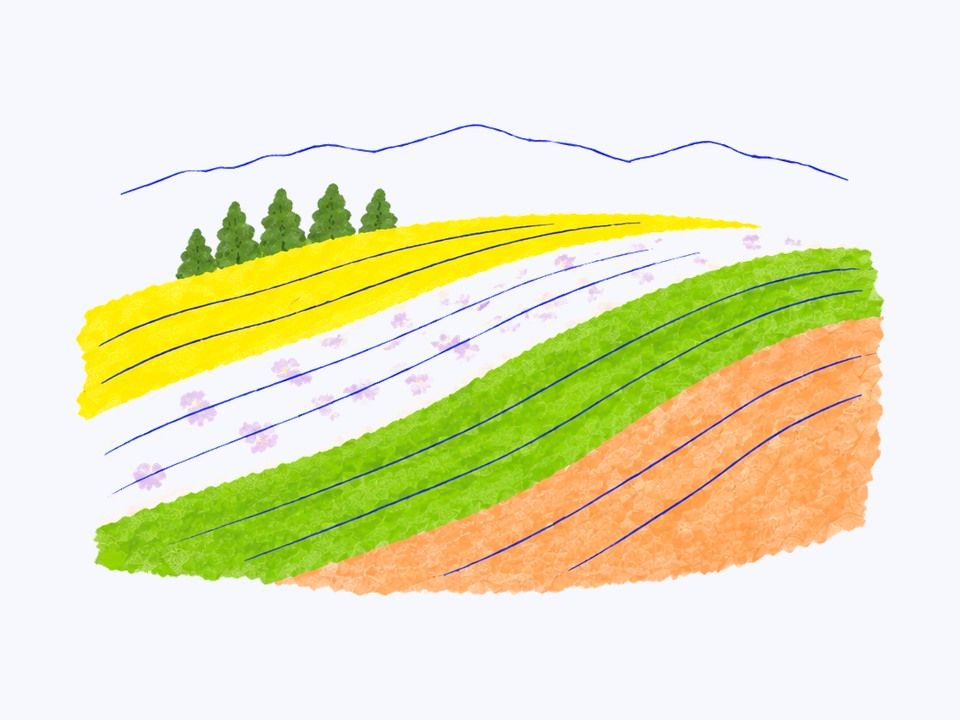
You think it's just scenery.
The golden patch is wheat.
White flowers are potatoes.
Come back next year,
and they'll have moved.
Biei's patchwork hills: which crops make the colours
One patch is usually one crop.
- Wheat
- Green in June, golden from mid-July. About 3,330 hectares, the largest crop
- Sugar beet
- Dark green right into autumn, used to make sugar. About 1,080 hectares
- Soybeans and other beans
- Green in summer, turning yellow and brown in autumn. About 910 hectares
- Potatoes
- White or pale purple flowers in early summer. About 700 hectares
- Pasture and fodder
- An even green, cut to feed cattle. About 2,460 hectares
- Green manure
- Yellow flowers from mid-September to mid-October are mostly mustard, ploughed back in to feed the soil
Areas are 2021 figures for the whole town of Biei (Town of Biei: Biei's Agriculture (美瑛の農業)), not only the hill fields.
Why Biei's fields change colour every year
Nature gave the slopes; people cut the squares.
NotebookDon't take someone else's photo to hunt for the same patch. The stripes of your year belong to that year alone.
The postcard hills, through farmers' eyes
A beautiful slope is hard to farm.
About 40% of Biei's farmland falls within subsidies for hilly and mountain areas with poorer farming conditions. The town hall's farming report says it plainly: sloping fields keep farm work from being efficient. The rolling land we find most beautiful also makes the work harder for farmers.
In 1955 Biei had 2,419 farm businesses; by 2020, 406 were left. Fewer than one in five of the town's farm businesses remain. Someone from the tourism association also pointed out in an interview that this landscape wasn't made for tourism: farmers grew it, generation after generation. Pests and disease carried in on shoe soles may harm not only this year's crop, but also the crops rotated in after it.
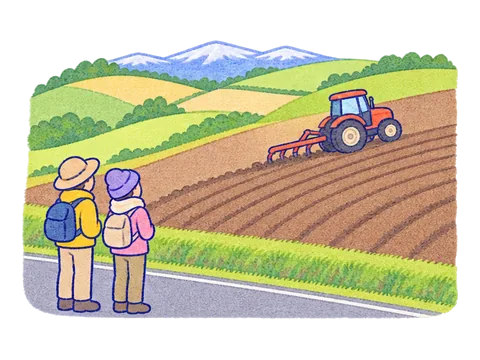
Our one minute of colour is someone's year of work.
Based on Biei's Agriculture 2022 (Japanese) / Biei Tourism Association interview (Biei farm-stay council)
What colour Biei's hills are each month
Stand in one place and watch it change through the year.
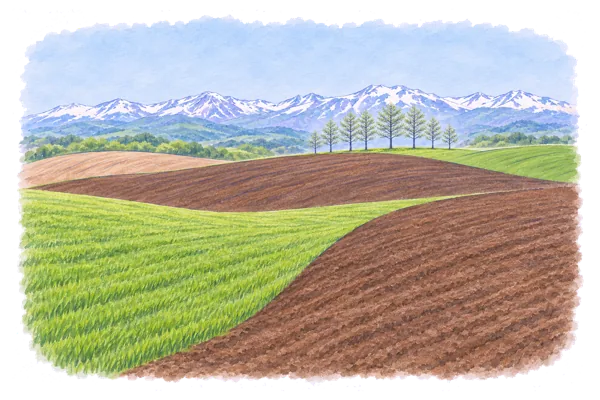
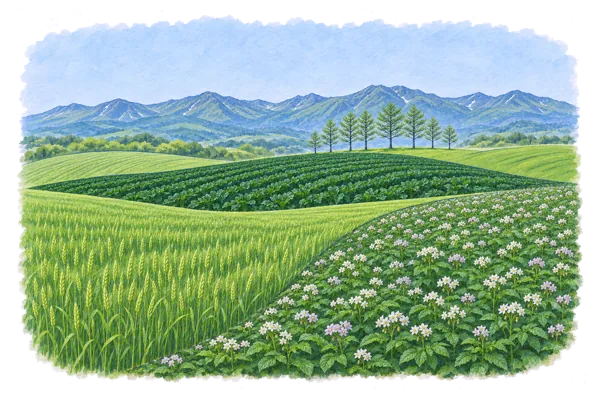
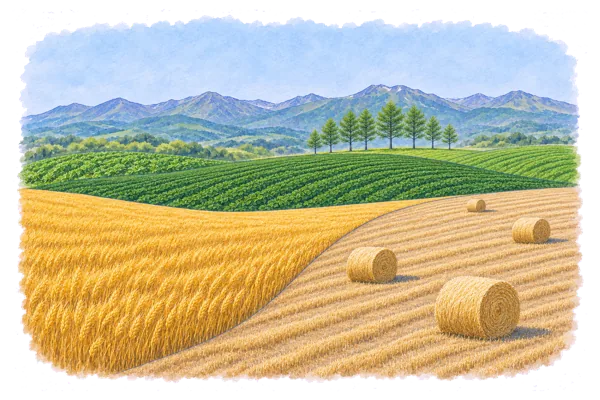
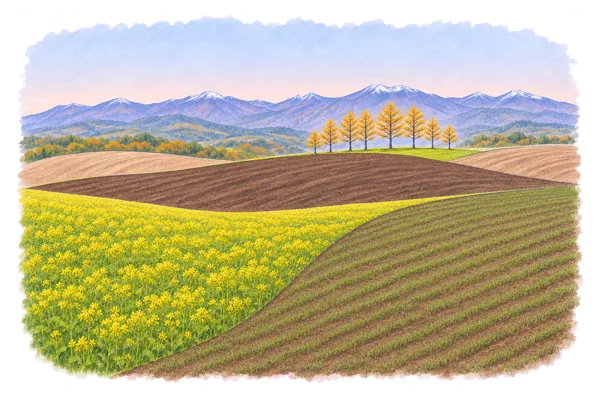
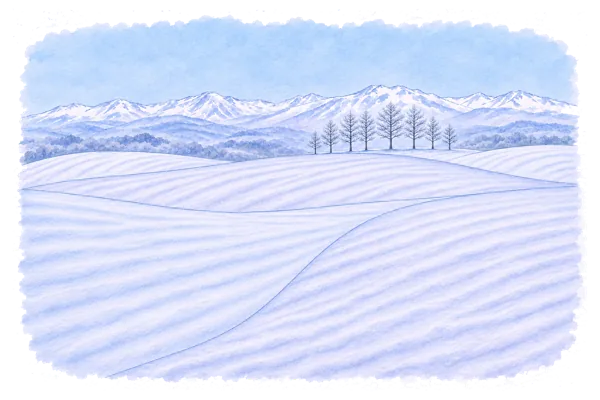
The same hill,
the same field edge.
Next year, a new colour.
NotebookFor the most colour, I'd go in mid-to-late July: the wheat is turning yellow while beans and vegetables are still green.
What grows under Biei's winter snowfields
Without a winter, it bears no grain.
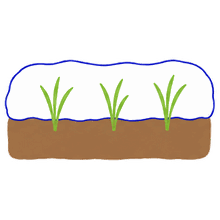
- SeptemberSown, and sprouting in about 5 days.
- With a few leaves, it spends the winter under the snow.
- Harvested in late July the next year, all within about 10 days, for fear of rain.
- Over 90% of Hokkaido's wheat is this autumn-sown kind, mostly made into udon.
NotebookSeen from the roadside, a winter snowfield isn't empty ground: under the snow lies next summer's sheet of gold.
Reading the patchwork hills: how to go about it
You can read them without entering the fields.
- When to go
- Mid-to-late July for the most colour; autumn for the mustard
- Where to stand
- Viewing parks and places you can't enter →
- How long to stay
- 20–30 minutes at one viewing park. First find one gold, one dark green and one light green patch
- If you want to walk in
- Join a harvest with an organiser →
Why Biei is all rolling hills
The hills formed before the Tokachi range.
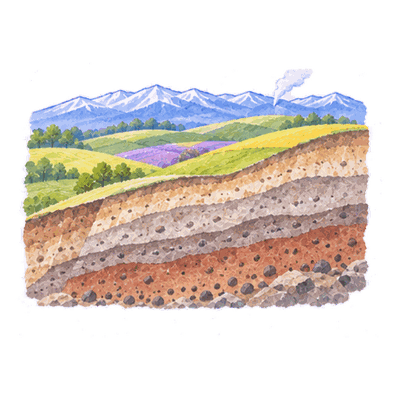
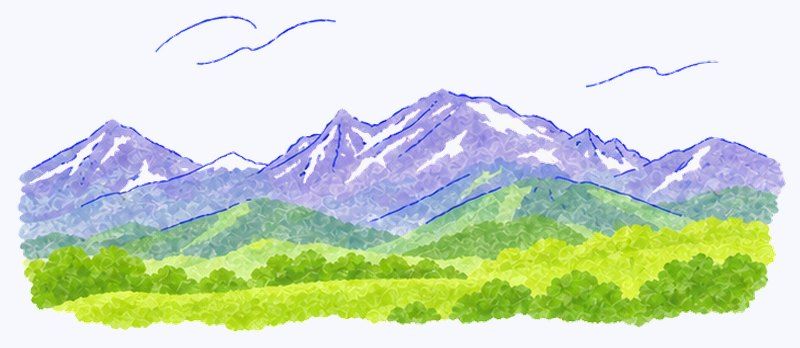
NotebookEveryone photographs the mountains first. But look down at your feet: the hills are older than the mountains, which came later.
What are the black lines on the March snow?
What are the black lines on the March snow?
It isn't dirt.
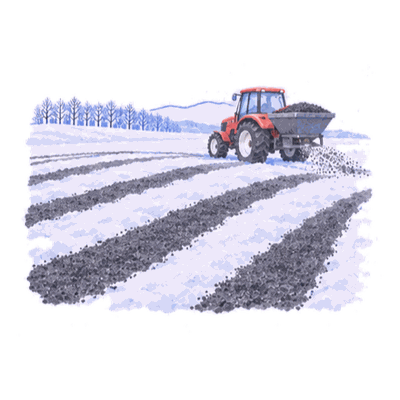
It's snow-melting powder spread by farmers. Black absorbs heat, so the snow melts sooner. In March 2008 the Hokkaido Shimbun photographed Naka-Furano from the air: the plots already black were the ones near the farmhouses, to be used as seedbeds.
NotebookMarch isn't photogenic, but it's when the order of farm work is easiest to see. Where it turns black first, work starts first.
FAQ
Are the stripes the same every year?
No. The crops rotate, so where the colours sit changes.
Can I walk into the fields to look at the soil?
No. Soil on your shoes can carry in pests and disease. JA Furano (JAふらの) asks everyone to stay out of the fields.
Can I walk on the snowfields in winter?
No. The Biei Tourism Association states it clearly: there are crops under the snow, and it's private land.
Flowers fade, wheat is cut.
The field doesn't end there.
It simply turns a new colour.
Read next
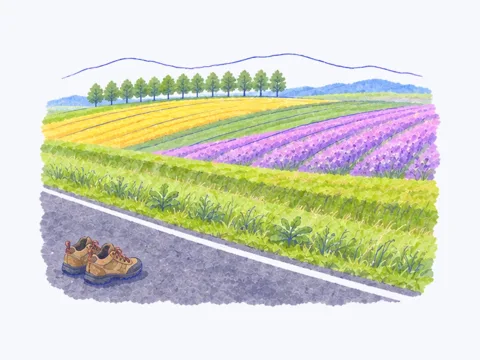 By the fields of Biei, why can't you take one more step?Where to stand to see these stripes→
 Furano's table: asparagus in spring, onions in winterWhat the stripes end up as on the table→
 December in Furano: snow by day, lights by nightThe month the stripes sleep under the snow→
Sources: 12
- Town of Biei: Biei's Agriculture 2022 (Japanese)
- Biei Tourism Association interview
- JA Furano: please stay out of the fields (Japanese)
- Hokkaido Development Bureau: how the hills formed, Q&A
- Same: pyroclastic flow deposits
- Ministry of Agriculture, Forestry and Fisheries: Biei's hills (Japanese)
- Hokkaido Research Organization: crop rotation (Japanese)
- Hokkaido Government: growing wheat (Japanese)
- Biei Tourism Association: the hills through the seasons
- Same: mustard flowers
- Same: etiquette
- Hokkaido Shimbun: snow-melting agent (Mar 2008)