
 Life, work and moving
2026.11 Furano, Hokkaido Notes before applying
Working on a farm in Furano, with farmers from spring planting to autumn harvest
How long to stay, what you really take home, how to apply
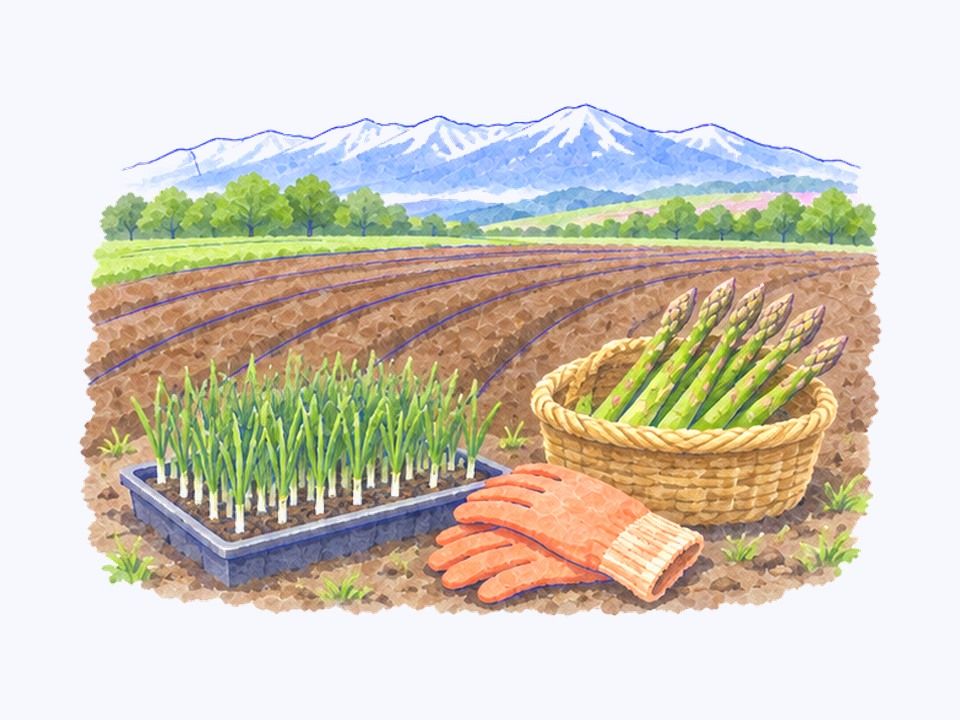
You want a season in Hokkaido,
and your hands in the soil.
At 7:00 a car fetches you.
You come back muddy at dusk,
day after day, March to October.

Farm working holiday in Hokkaido: how long to stay
First decide: a holiday, or a way of life.
Just trying it: 1–3 hours
A hands-on experience you pay for
It isn't work, so you can join as a tourist.
No work visa needed
Choosing a harvest experience →About a month
Negotiable, but you won't save much
Allowance: ¥5,000 for 20 days or more, ¥10,000 for a full month. The dorm and meals on working days take about ¥60,000 off first each month.
Ask about start and end dates first
See the recruitment terms →A season: Mar–Oct
What this job suits best
Complete 7 months for another ¥70,000. From the second year, an extra ¥20,000–30,000 a month.
Early 2027 recruitment open
Apply on the official page →A full year
In winter, change place or job
Nov–Dec picking mandarins in Ehime, Jan–Mar sugar cane and a sugar mill in Okinawa. If you stay in Furano, openings aren't guaranteed.
Ask by September
Three options for winter →A day on a Furano farm, and who's there
Someone who did it for four years loved the breaks most.
Around 9:00 or 10:00, and again about 15:00, the farmer calls a break. Turn a plastic harvest crate upside down and it's a chair. There's tea and snacks, sometimes a just-picked melon or watermelon. Breaks are meant to be 15 minutes, but sometimes the chat runs past half an hour, and everyone rushes to catch up.
The first week, your whole body feels heavy and sore. When you sign, the co-op staff warn you: the first week is the hardest. At the end of the day you sometimes hear a thank-you, and sometimes go home with vegetables from the farmer.
Back at the dorm in the evening, up to a hundred or more people live like classmates of different ages. They tell each other in the corridor what they did today. There's gossip that spreads fast, and times you want to be alone but can't. Some still keep in touch with dorm mates ten years on; others say they had so much fun it's hard to go back to commuting to an office every day.
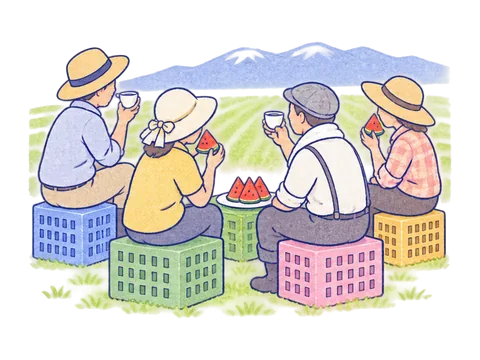
Recruitment began in 1996, with over 2,000 placements in total. The recruiter says more than 20 people found a new path here: farming, starting a family, or staying on in other work.
From someone who worked four years / someone who lived in the dorm for ten months (2021–22) / the recruiter
Hourly pay and what you actually receive
Look first at what's taken out.

Figures published by Sasurai Nogyo Nikki (さすらい農業日記): 175 paid days in 7 months (including 10 days of paid leave; 165 days actually worked), ¥1,137,424 taken home. In June the writer took 7 days off; October included 10 days of paid leave and the completion bonus. It rained a lot that year, and the writer calls it a low year.
NotebookThe hourly pay looks decent, but rain decides what you take home. Don't multiply ¥1,200 by 8 hours by 30 days. With all meals ordered and 21–25 working days a month, the estimate leaves ¥110,000–140,000 for residents and ¥70,000–100,000 for non-residents.
What farm work involves each month
Tap the month you want to come.
MarWork begins
The workPicking and packing greenhouse asparagus; raising watermelon seedlings
The hard partStill snowy outside but warm in the greenhouse: big temperature swings
AprPlanting
The workPlanting out tomato, melon and watermelon seedlings; asparagus
The hard partBending over, carrying seedling trays
MaySpring rush
The workTwo rounds of asparagus picking a day at the peak; transplanting onions
The hard partDoing the same motion for a long time
JunLess work
The workTraining plants, removing side shoots, weeding
The hard partWork drops off, and so does income
JulThe harvest rush begins
The workTomatoes, watermelons, sweetcorn
The hard partHeat and heavy loads
AugThe busiest month
The workMelons, watermelons, onions, garlic, broccoli, sweetcorn
The hard partWatermelons are picked even in light rain
SepAutumn harvest
The workPumpkins, potatoes
The hard partWork stops when it rains a lot
OctWrapping up
The workLast tomatoes, pulling up plants, taking down greenhouses
The hard partDust, and the cold sets in
Nov–MarHeading south
The workJA's cross-region relay work: Nov–Dec picking mandarins in Ehime, Jan–Mar harvesting sugar cane and working at a sugar mill in Okinawa
The hard partIf you stay, there's much less work
Work summarised from the recruiter's crop guide and the recruitment page; "the hard part" draws on accounts by people who did the work. Every farm is different.
NotebookThis job won't keep you in Furano all year. It's more like a life that follows the crops south. To stay all year, you'll need another job for winter, so think about it before you come.
A day of farm work
An early start, with fixed hours and breaks.

- 7:00Meet up and ride the co-op's or the farmer's vehicle to the fields
- 7:30Start work, with a 15-minute break
- 12:00An hour for lunch
- 17:00Finish; another 15-minute break in the afternoon
- 17:30Back to the dorm. One day off a week, about two days for Obon
Dorm rooms and daily life
Whether you last depends more on how you live than on the hourly pay.
What people who worked there noted
- About ¥850 an hour around 2010, ¥1,100 in 2023, ¥1,200 in 2025
- Days off announced that same morning, and finishing early halfway through: both happened (2025)
- Greenhouse crops are steady income: there's work even in the rain (2025)
Sources: a former dorm resident's blog (2025), Sasurai Nogyo Nikki (Jan 2026). Taken from public accounts by people who worked there, describing that year.
How to apply for a farm working holiday in Furano
Make sure you can work, then send your CV.
- Check first
- You need a visa that lets you work. The official recruitment doesn't say whether working holiday visas are accepted or how much Japanese you need, so ask in your first email
- Get the visa
- Working holiday visas have an age limit, open in rounds, and you must apply in person. Check dates with the Japan-Taiwan Exchange Association, and buy flights once you have the visa
- Apply
- Press 応募する (Apply) on the official page and attach a Japanese CV; if you don't have one as a file, wait for the online CV form by email
- Interview
- A phone interview; about a week later you hear whether you're accepted. Phone 0167-22-1624 (weekdays 9:00–17:00)
- Have money ready
- Dorm charges start on arrival, even on days without work. Have enough for living costs until your first pay, plus a return flight
You can copy the whole first email and fill in the blanks:
More to ask before applying
Five things to ask before applying for farm work
What the recruitment page leaves out matters more than what it says.
- Whether foreigners are accepted, and how much Japanese: not on the recruitment page
- Whether your visa allows this work: for a working holiday, check with the Japan-Taiwan Exchange Association first. From 1 Feb 2026, Taiwanese people can get one twice in a lifetime
- Whether you can arrive late or leave early: dates are negotiable, but they affect the allowance
- When the season really ends: the 2027 recruitment page says mid-October in one place and late October in another
- Rainy days without work: how pay and meals are handled
NotebookPeople who did it say that if you only want to save, resorts and factories with night shifts are usually quicker. But if you want to know how an onion reaches the table, few jobs compare with this one.
FAQ
Is it OK with no experience and no driving licence?
The 2027 recruitment page says no experience is needed, and there's transport to the fields. Ask about age and a licence.
Can I work just one month?
Start and end dates are negotiable, and from 20 days there's a small allowance by days worked. But after the dorm and meals, not much is left.
Can I stay in Furano in winter?
Some stay on at a produce sorting plant or move to a ski resort, but places are few, so ask first. The three paths are in this article.
The crate you filled,
goes to a table you won't see.
But you'll recall if it rained.
Read next
 Furano's table: asparagus in spring, onions in winterWhen what you pick reaches the table→
 Furano at minus twenty: what to wear outsideThere's still snow when work starts in March→
 By the fields of Biei, why can't you take one more step?Whose fields they are, and how not to intrude→
 After the autumn harvest, can you stay on in Furano and work?Three paths for Nov–Mar→
 You love Furano in summer. Could you live through its winter?If you're staying longer than a season→
Sources: 5
- JA Furano Group: Agri Plan (アグリプラン) (Japanese)
- JA Furano Group: farm helper recruitment (Japanese)
- Sasurai Nogyo Nikki: 2025 pay (Japanese)
- Former dorm resident's blog: changes in 2025 (Japanese)
- City of Eniwa: Hokkaido minimum wage (1 Oct 2026) (Japanese)